Brex's Data Marketing Play Teardown: The Spend Signals Behind AI
tldr
Brex turned boring expense data into a monthly ‘Benchmark’ report that acts as an economic scoreboard. By analyzing customer spend data on AI and SaaS, they create a recurring content engine that drives ego-bait distribution and builds authority. It’s a masterclass in data marketing, even if their distribution strategy relies too heavily on organic mentions.Most brands publish content-shaped oatmeal. Brex turned boring expense reports into a monthly cultural barometer in a data marketing play that is great…but also has a lot of potential.
The core play
Brex turns private spend data into a public scoreboard. Credit card line items, turned into gold. Their Head of Data takes transactional data from 30,000+ companies and creates a monthly “State of the Union” for SaaS spend, AI, and a rotating cast of categories. It is ambitious, granular, and one of the most interesting economic signal engines running right now . Brex’s content data engine feels powerful and has a lot of potential but it’s surprisingly quiet at the top, missing leadership amplification, media boosts, and basic website oomph.
As a reminder, I look at data marketing plays across three dimensions:
- Data: Raw credit card transaction data powering the engine.
- Insights: A monthly narrative explaining where the money is moving and how.
- Distribution: The “ego-bait” strategy that gets other brands to share the charts.
What Brex Is (In One Breath)
Brex is a modern corporate card and spend management platform that has been killing it with a $10bn+ valuation and a recent expansion to Europe. Their new content data engine, The Brex Benchmark (launched June 2025), publishes monthly snapshots of what startups and enterprises are actually buying from AI agents to business travel to books.
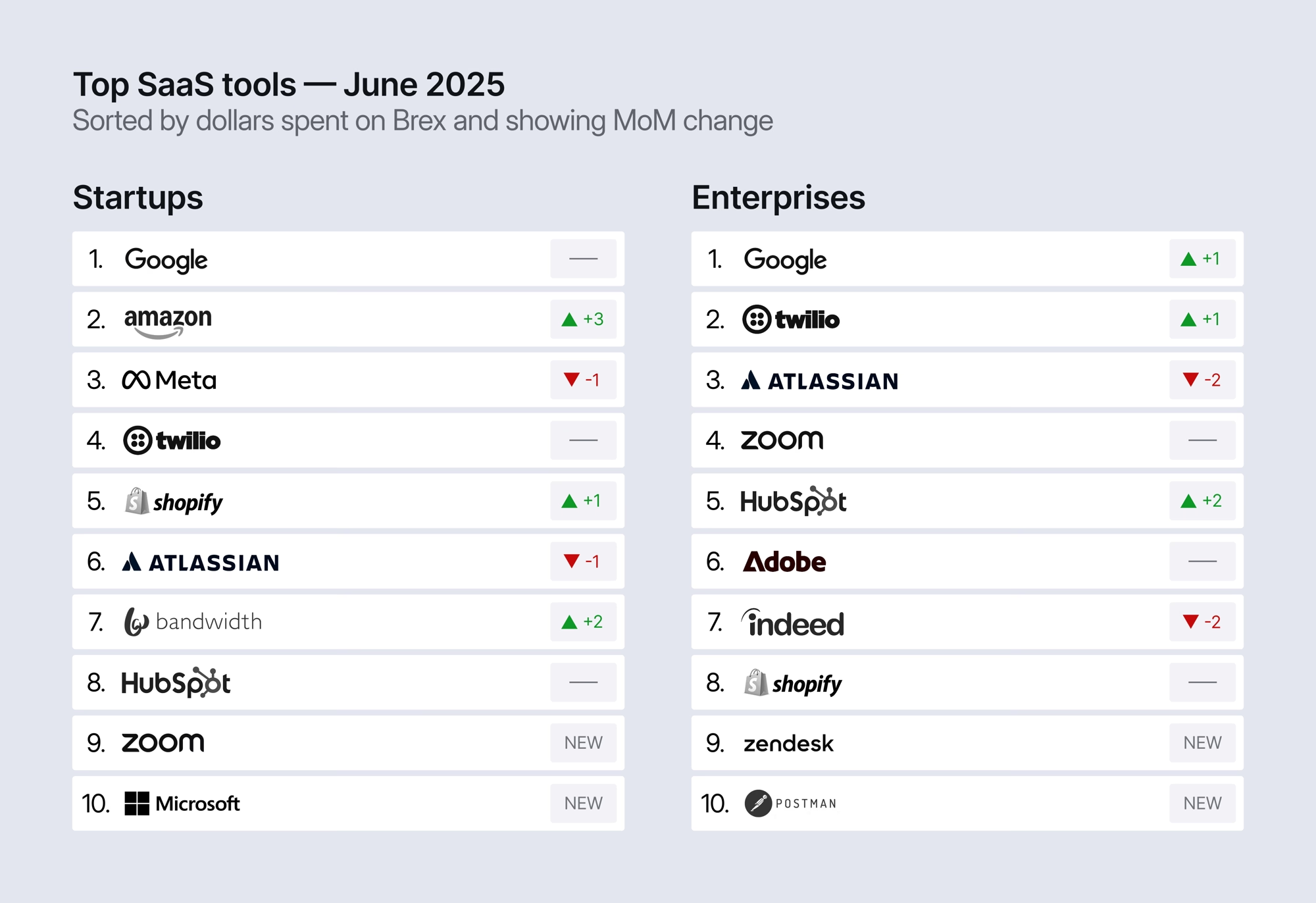
The Brex Benchmark (SaaS).
Data: The Layer That Trains the Market to Come Back
The Brex Benchmark
B2B data reports can range from daily and automated to quarterly or even annual (yaaawn). Brex does Monthly, which is kinda in the middle. It includes:
- A leaderboard analysis of top ten vendors by both SMB and Enterprise spend, including ranking changes
- A pullout of AI vendors with the same SMB/Enterprise breakout
- A rotating analysis for things like travel, top newsletters or books bought, and more. This is where it gets interesting.
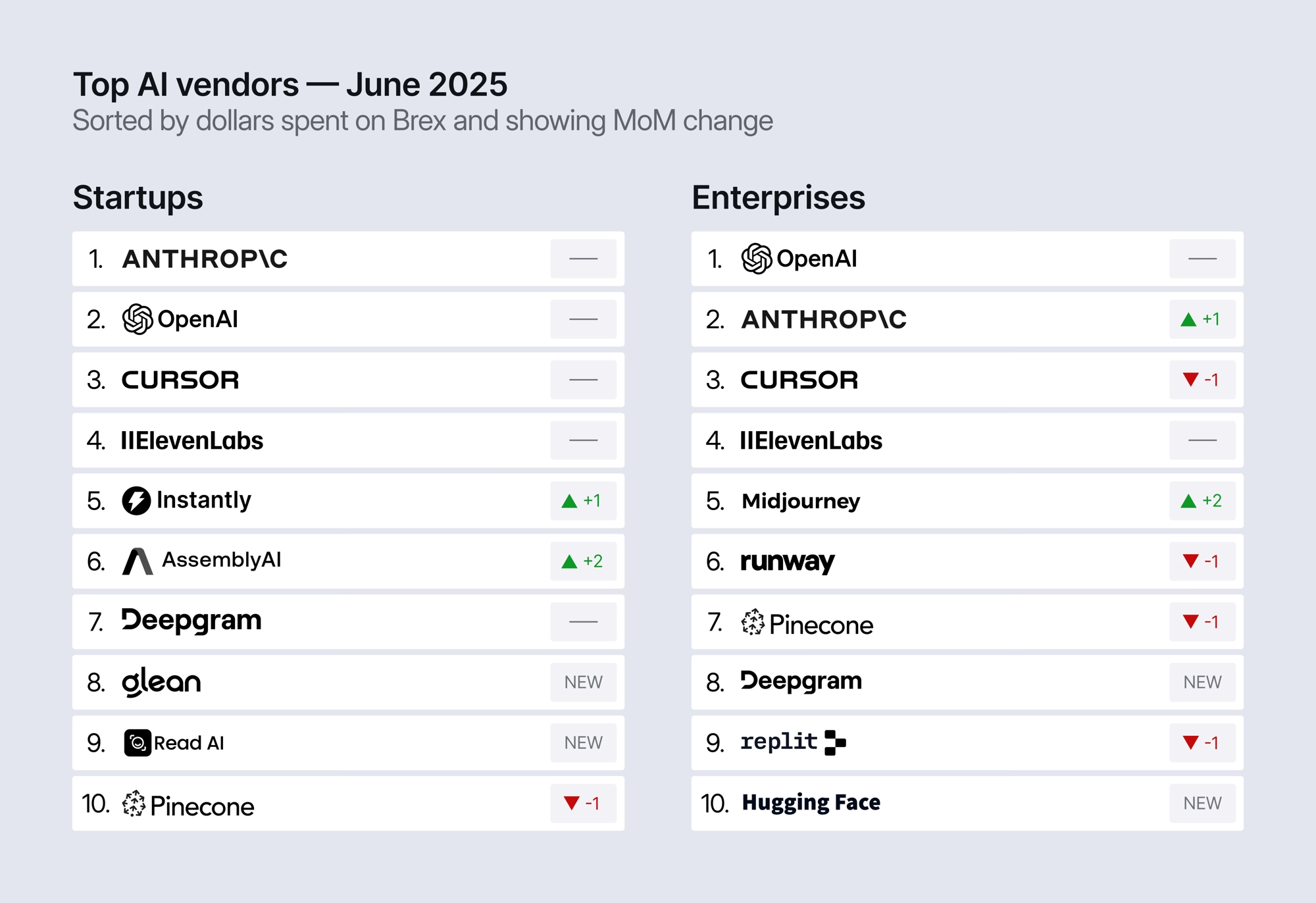
The Brex Benchmark (AI).
The Brex Benchmark is:
- Branded. It has its own name…but even Brex doesn’t use it so frequently. No hub page. Nada.
- Ungated. Lives directly on their resource center in blog post format.
- Segmented. Always splits data by Startup (<250 employees) vs. Enterprise (250+) and by month. No way to compare months or see all the data there.
- Non-standardized. There’s no one page to go to in order to track trends, nor is it linked to any automatically updating dataset.
Data Scorecard
The index rides on first-party financial transaction data. That is incredibly hard to fake.
- Frequency: Medium (Monthly) and started June 5, 2025.
- Format: Low. Honestly, the data itself is just 2-3 tables of leaderboards for where spend takes place. The real interesting part is the research around it (see in Insight below). Format is squarely a monthly blog post with some consistent charts and some individual analyses.
- Uniqueness: High (Actual transaction dollars, not surveys).
- Methodology: Transparent and has been updated.
- Granular Depth: High. They can see that you bought Atomic Habits or subscribed to a specific Substack.
- Programmatic: Low. None yet and feels pretty far away given how there isn’t even rollups of the data across multiple reports.
- Commercial Relevance: Low. This might be the weakest point for the benchmark. Finance folks are likely interested in the trends but there is not a direct line from what you procure to how you do it. The flexiblility of the analysis portion of the report does leave room for this. Either way, definitely good for general brand visiblity.
- Company Transparency: Brex does list names of the actual companies and vendors transacted with but never reveals who is spending which is a decent privacy play. It also means they can directly prop up their own customers as success stories which is a motion we’ll talk about soon. For example:
“Brex customers like Speechify and Vapi are scaling AI voice products fast, and even VCs are bullish on the space.”
Privacy does matter for them since, of course, people get skittish about oh, I don’t know, companies sharing their spend patterns globally. Which is why they assure you it’s kosher:
All analysis conducted for this report that uses Brex internal customer data is anonymized and aggregated for privacy. To learn more about how we use data in anonymized or aggregated form for these trend reports, email us at privacy@brex.com
The Flavor of the Month Analysis Strategy
This is Brex’s smartest move - using a “Fixed + Flex” model:
- The Fixed Layer: Every month, you get the top AI and SaaS vendors. This creates the longitudinal “Scoreboard” habit.
- The Flex Layer: Every month, they add a “Special” based on a specific theme. For example:
- August: Books. They used item-level receipt data to see exactly which books founders were buying (not just “Amazon Bookstore” spend).
- September: Travel. Offsite frequency and airline trends.
- October: Infrastructure. The shift from tinkering to building.
Brex’s monthly cadence matches the rhythm of a finance cycle. It feels weighty, like a bank statement you actually want to read. But it also creates a big lift for the data team since it’s a brand new analysis every month. Good for readers, hard to pull off well.
Insight: The Research Layer That Is Killing It
The research posts are really where it gets interesting. Besides the “regular” posts about vendor leaderboards, there are deep dives that don’t even follow the regular monthly cadence:
Brex Benchmark Reports (2025)
- May 2025: Launch of Brex Benchmark. Focus on “Anthropic tops startup AI spend.” Link
- June 2025: AI voice agents and voice stack trends. Link
- July 15, 2025: Special on “How startups are bundling tech: 2020 vs 2025.” Link
- July 2025: AI infrastructure spend surge analysis. Link
- August 18, 2025: Special on top AI and business books. Link
- August 22, 2025: Special on paid newsletter subscriptions. Link
- August 2025: Enterprise growth trends and spending shifts. Link
- September 17, 2025: Special on corporate travel trends. Link
- September 2025: Focus on coding platforms Replit and Vercel. Link
- October 2025: OpenAI’s platform shift and 80% YTD spend growth. Link
Some of these are really, really smart. For example, the best B2B newsletters and top B2B books are not only based on very unique transaction level but also amazing because they have built in amplficiation from influencers.
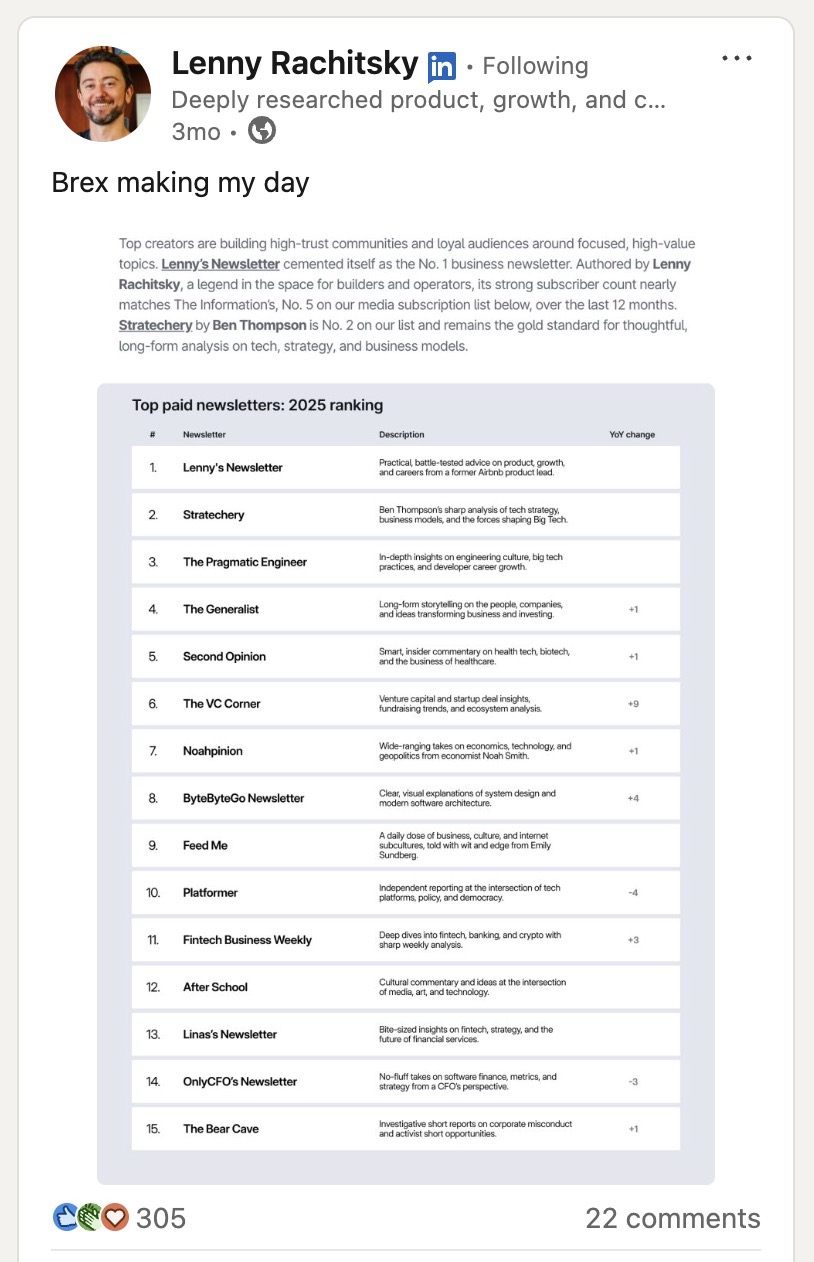
Imagine what you'd need to pay for amplification from Lenny
Humans?
The research has a byline, which I always like. In this case, it’s always Sumeet Marwaha, Brex’s Head of Data and a former Postmates product analyst. Sumeet also pushes this on LinkedIn but there aren’t other people that are bylined on the research. In some cases, this feels like a report written by a really smart team, rather than a conversation led by an expert, and is a little lacking on the marketing amplification side (more soon).
Brex also publishes other data-driven content, including things like survey-backed long-form content research. One example is the CFO Imperative report, which surveyed 500 CFOs survey piece.
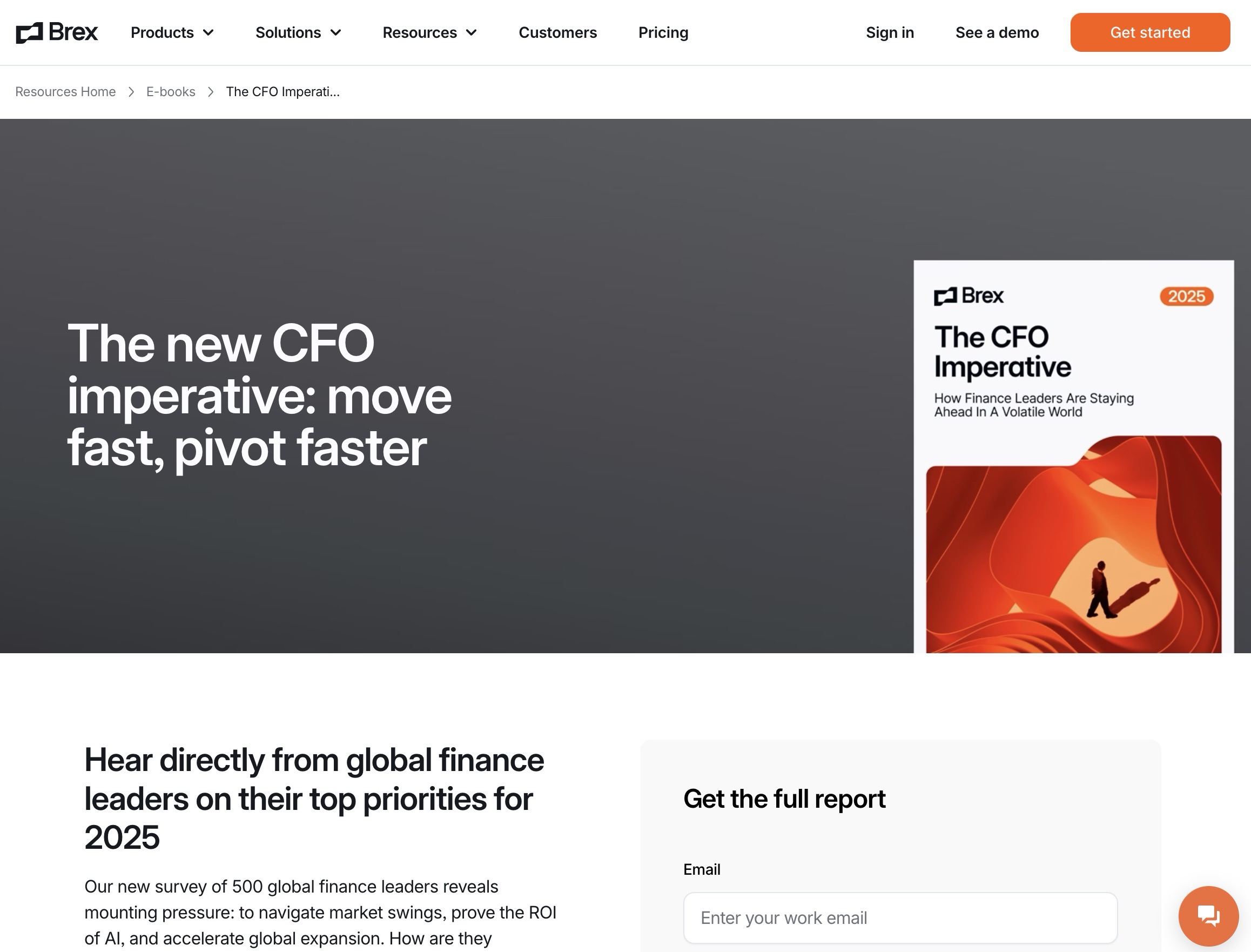
A survey-based data report by Brex
Distribution: The Loop That Turns Interest Into Pipeline
There is a ton of opportunity here. Brex seems to approach distribution as an owned media play - posting on their website, juicing with sporadic author + brand LinkedIn posts, and promoting in their weekly email (65k subscribers, which is nice). There’s fairly minimal earned media here (think media or aggressive social distribution) BUT there is a very strong ABM play potential by mentioning specific accounts and for amplifying customers (which is their jam).
Let’s talk about that for a second.
The “Billboard” Flywheel
Brex has a history of treating their customers as the stars. They do this with things like sponsored Times Square Billboards for customers, regularly reposting announcements made by their customers on LI (see BoomPop here), and posting about their customers in their newsletters. At least part of this is through a very smart rewards program.
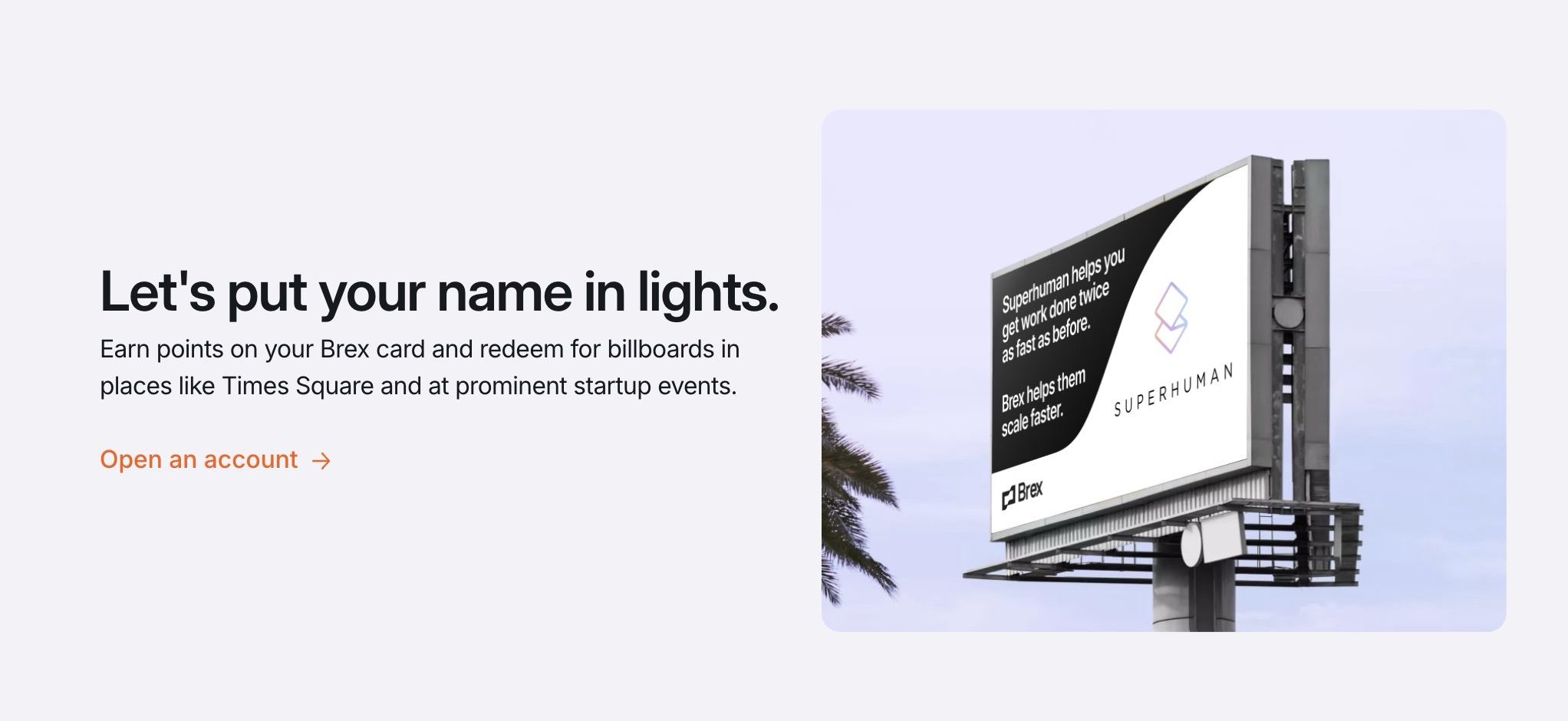
From Brex's website - their banner sponsorship program
Distribution of the benchmark seems to be a similar play, where the best social distribution comes from customers being mentioned as getting lots of Brex Bucks. For example, the CEO of Read AI posted about being in the top ten AI spend categories and picked up 191 likes. Brex’s post about it picked up 41. These posts usually outperform Brex’s own posts. The CEO of Pinecone posted and got 72 likes while Brex’s own post about the same research just got just 42 likes.
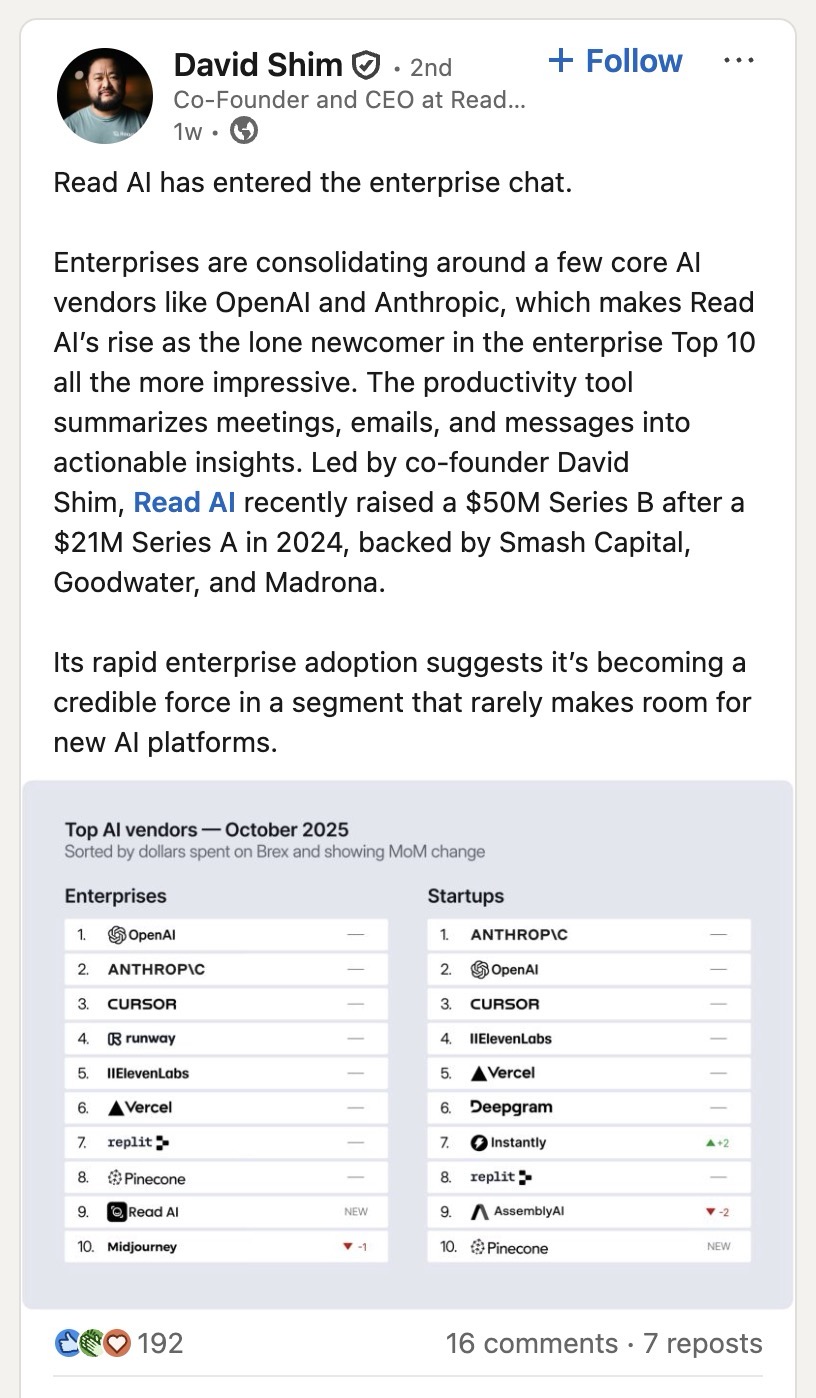
Crushing it with earned amplification from leaderboard-mentioned companies. A great ABM play.
I like this play and I like how organically it fits in with their broader strategy. Brex provides the stage; the vendors bring the audience. They are essentially acting as a PR agency for the companies growing on their platform.
Come on, People!
Here is the weird part.
For a data play this strong, the executive team is surprisingly quiet.
- Pedro Franceschi (CEO): I checked his feed. He isn’t posting about the Benchmark.
- The CMO Role: Their CMO left a few months ago but he wasn’t posting about it when it launched earlier.
At Brex, the Benchmark feels like a great initiative from the Data Team that gets some support but isn’t a top-down strategic narrative. If the CEO isn’t quoting the scoreboard, why should the market?
The Branded Hub Opportunity
Right now, the entire engine lives as a series of lonely blog posts.
There is no central “Benchmark Hub.” No longitudinal charts. No easy way to “Subscribe to Benchmark Updates” without getting generic product spam. They are building a library of insights but storing them in a messy drawer. That is a hit for SEO, impacts accessiblity and is not going to help with general brand visibility for the benchmark.
Media Amplification
There’s also shockingly little amplification of this content in media. You’d think this level of spend granularity about high-profile AI spend would garner a ton of pickup. After all, we saw what Profound’s data marketing was able to land a nice amount of earned coverage by talking about Reddit’s importance; surely data on OpenAI and Anthropic spend should be a great door in to media? But still, when looking on even industry sites like Techcrunch…crickets.

Nothing doing with media pickup of the benchmark
The Verdict
What I Love
The “Customer as Hero” DNA. Just like their billboards, they use data to shine a light on other companies. It’s generous, smart, and builds immense goodwill. It also lets them subtly flex that they work with great companies.
The Granularity. Item-level receipt data (books, newsletters) is a massive competitive moat. You can clone a survey; you cannot clone $100B in transaction volume. So much value for picking there.
The Scope. While it’s ambitious, I really like that they are choosing different subjects to deep dive in on a monthly - and sometimes bimonthly - basis. This is a lift but leads to far more interesting output and also to some creative ideas that create distribution flywheels (like the newsletter idea, which was gold).
What I Would Do Differently
Humanize the Data. Sumeet (or someone else) needs to step out from behind the byline. Be the pundit. Be the “Nate Silver of SaaS Spend.” Get more humans involved in distribution. Activate the CEO. Pedro needs to use this data to tell the macro economic story. “We see the economy before anyone else” is a CEO-level narrative.
Build the Destination. Stop publishing these as blog posts. Build a /benchmark directory that houses the longitudinal data so the SEO value compounds. This connects to my thoughts on running SEO like it’s 2025—building destinations, not just pages.
Lean into distribution. I’d be hesitant to juice distribution with paid spend because, as I mentioned above, the data isn’t very buy-intent. But there’s still a great runway here for media and SEO amplification.
Add more buy-intent data. I’d love to see more data that’s related to the challenges that Brex’s personas face. Average cost increases for software, total number of spenders, spend on business travel, etc.
Why The Engine Works
The part of this that works well is finding really unique data and having a fantastic data team that deep-dives into it. Brex does a great job of marrying the data with insights to create some really compelling reads that do get cited and do drive brand visibility.
How to Steal This Play (Without Stealing the Soul)
Want to build your own Benchmark? Here’s the playbook:
- Find your “Exhaust” Data: What data do your customers generate just by using you? (Spend, logins, edits, invites).
- Pick a cadence you can survive: Monthly is gold.
- The “Fixed + Flex” Model:
- 2 fixed charts (Rankings) for consistency.
- 1 flexible story (Deep Dive) for novelty.
- Name Names (The Billboard Strategy): Explicitly name the winners. Positive rankings get reshared. Be the cheerleader. Leaderboards always play well.
- Get the Boss on Board: Don’t let your CEO stay silent. Give them the “Stat of the Month” and make them tweet it.
- Create the “Ego-Bait” Kit: Send the “Winners” a badge or a pre-written LinkedIn post before you publish.
Done right, your data becomes the industry’s truth.
Part of the Data Marketing Teardowns series
- Part 1: Profound's Data Marketing Play Teardown: The Data Behind AI Search
- Part 2: This Article
- Part 3: Redfin's Data Marketing Play Teardown: From Housing Metrics to Media Megaphone
- Part 4: Ramp's Data Marketing Teardown: How They Turned 'Corporate Spend Exhaust' Into a Newsroom (And a Distribution Engine)
Let's make a deal. Drop your email and I'll let you know when I post new insights.