Ramp's Data Marketing Teardown: How They Turned 'Corporate Spend Exhaust' Into a Newsroom (And a Distribution Engine)
tldr
Ramp pulls off modern B2B first-party data marketing across a massive dataset, a strong analyst-coverage layer and a new (and very sophisticated) reporting layer across individual SaaS vendors. The output is a citeable research product on top of first-party spend data, which uses a very well diversified distribution engine (social, PR, Substack, website, executives). It’s an all-in corporate effort but it does have some kinks, including ICP-relevance (which makes it a brand play, not a top of funnel play) and jagged exec support.The Big Picture
Ramp swapped out blog posts for spend data that speaks volumes of their transaction volumes. They took a good hard look at where they have critical mass and the ball landed on payment data across 50,000 companies. Companies don’t want their spend exposed…but the aggregate spend data (with the right distribution) generates great conteng without any risk.
Ramp uses the anonymized transactional data in couple of formats. They evolved from blog posts (think posts like the Top ten Business Meeting Restaurant) to real-time benchmarks on top AI models that companies are paying for. While some traditional content writers are looped in, the highlight is how they tap an analyst to write (and speak!) publicly.
The most impressive evolution of this is a recently launched network of pages that spell out leaders in individual software categories - Ramp Rate - which launched in late January 2026.
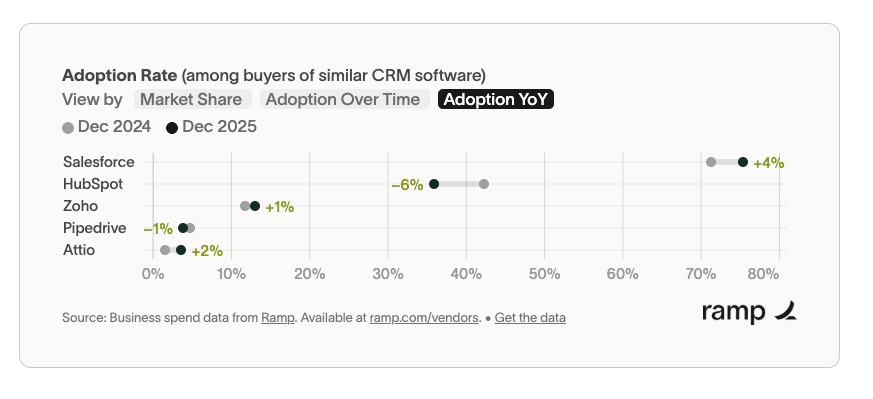
Overview of CRM penetration from Ramps newly launched Ramp Rate
Some Highlights from Ramp’s Data Plan
- Humans with real credibility (and real bylines) owning the narrative, then getting out there and sharing on Substack, LinkedIn, and media. Data without a person out there to tell the story ends up falling flat every time.
- Packaging that travels (embeddable charts, downloadable data, copyable visuals), with data packaged in short-form content, downloadable reports, social and programmatic pages.
- Distribution loops that are strongly diversified. Specific channels include tapping their CEO, Eric Glyman, very strong PR collaboration, an owned and bylined Substack, a self-service data hub, and programmatic pages.
Let’s get into what works (and where it can work better).
The humans: Ramp treats authors like assets (and it shows)
A lot of companies hide behind 'Ramp Team.' Ramp does the opposite: they build recognizable operators.Chief is Ara Kharazian (Economist, Ramp), the center of gravity for the research brand. Ramp consistently positions him as a non-commercial analyst (and he brings the credentials, as an ex-Square economic research lead with consulting experience and a growign amount of media citations). You can see his Ramp author page here (more on that soon) or see him on LinkedIn here. This isn’t a solo effort though. Here’s two tells of some very real comms maturity on the analysis/media collaboration:
- Ara’s LinkedIn page shows his contact details as… Ramp’s press email.
- The Ramp Rate homepage showcases a scroller of media pickups (and isn’t stuck in the 00’s with just mainstream publications; I see posts from The Deep View, Exponential View, and Cautious Optimism hiding there)
Ara’s not the only writer.
One other thing I like here is that Ramp boosts up its writers. For example, check out Ian McCue (Senior Content Marketing Manager)’ profile page. Ramp treats writer profiles like a mini media kit: education, domain focus, and background. Ramp also links author LinkedIns, which is a great “these are real people” trust cue: LinkedIn | Ramp page

Ramp's author pages showcase writer expertise, not just names
Why this matters: It’s not “content marketing + data.” It’s content + research + comms working together as one system.
The content architecture: three lanes that reinforce each other
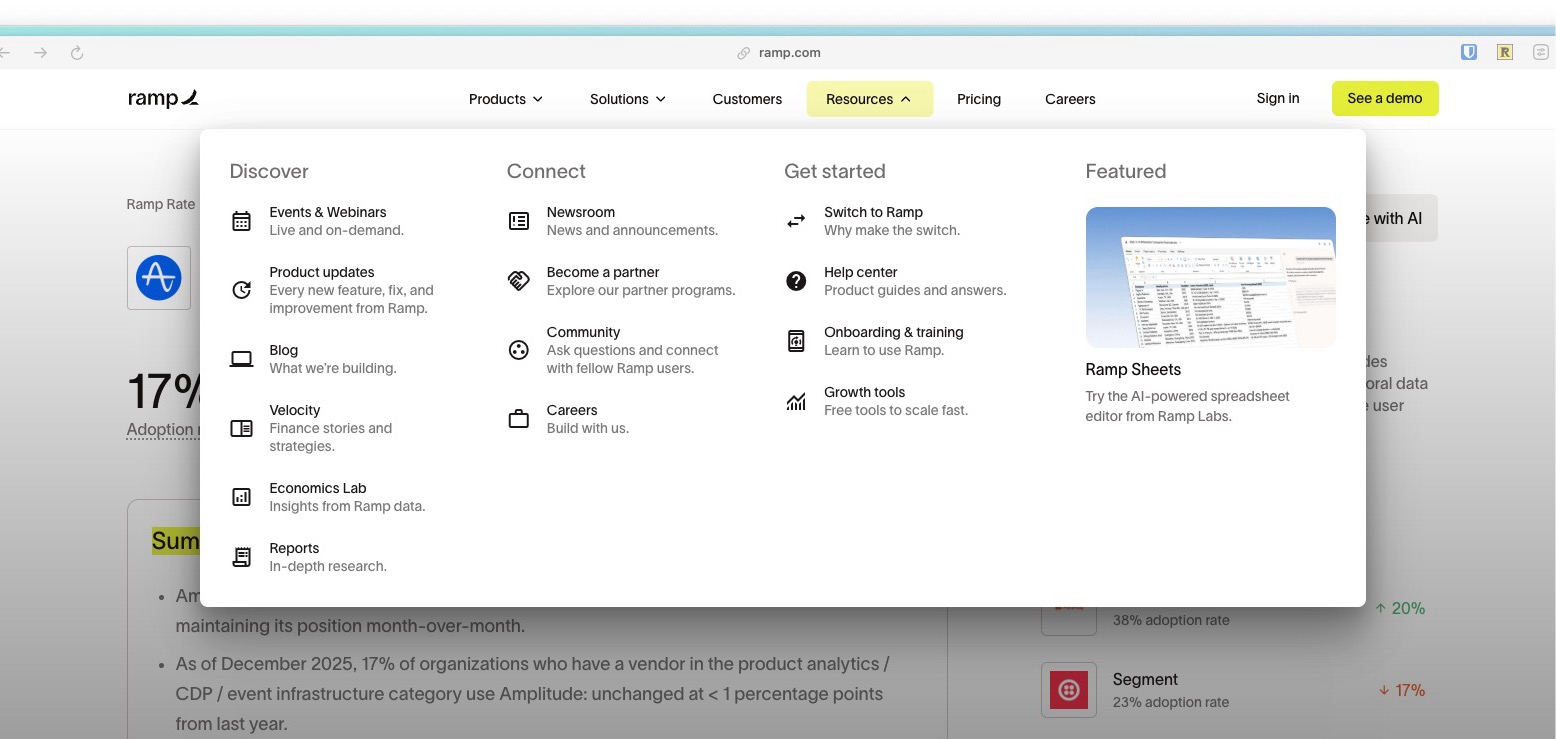
Ramp's navigation makes their data products easy to discover
1) Velocity: “financial stories & strategies” as attention gravity
Velocity is Ramp’s newsroom layer.
It keeps Ramp in the conversation around what finance leaders care about. They run a decent playboko here but, to be frank, most of the posts tap their broader network of speakers instead of their proprietary data (which is important; I think the authenticity of humans being featured is a great way to kick back at AI slop overload).
Ramp still does tap the underlying first-party data well in a bunch of the posts. For example, their AI Index coverage is packaged as a clean narrative post (“Business AI adoption flatlines”), with a research tone and tight claims. Velocity post.
There are also nice little touches here that need to be showcased. Beyond embedding and citing data, I love the way there’s no fear to talk in first-person. Also, I’m always a fan of in-depth bios like the one on this page. I would like to see more opinions or strong positions but all in all, these are very solid pieces of content.
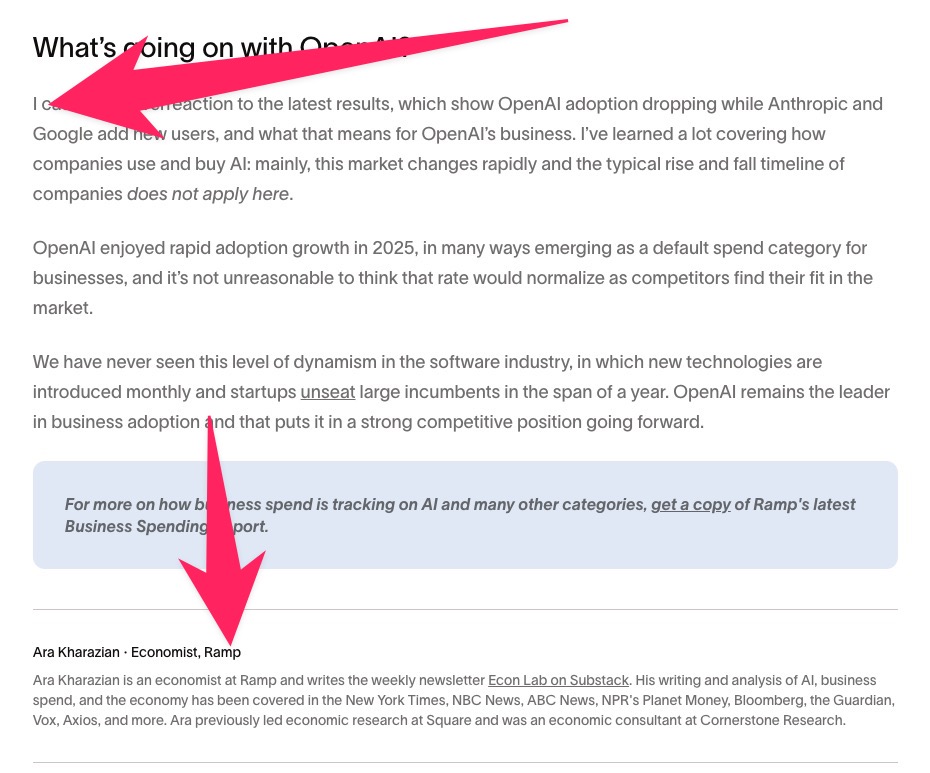
Nice touches here - bios + first person
2) Ramp Economics Lab: the authority engine
The Economics Lab is where Ramp turns from “fintech that writes” into “fintech with an economics desk.”
They have two key indexes that are fully embeddable,have clear methodologies that are shared, are interactive (using Datawrapper.de) and can have raw data downloaded without any gate.
The first index is the AI Index, positioned as “monthly measurement of AI adoption by American businesses” with explicit sample framing and methodology. The AI Index is, obviously, very timely and is, as far as I can see, their best backlink and citiation generator out there.
What makes this particularly impressive is how in-depth the Datawrapper embed is. It’s not just a static chart—it’s a fully interactive visualization that readers can explore, embed on their own sites, and download the underlying data. The embed includes multiple views (overall adoption, by business size, by model), time series data, and methodology notes all in one interactive package. This level of detail transforms a simple chart into a reusable research asset that journalists and analysts can cite and embed without friction.
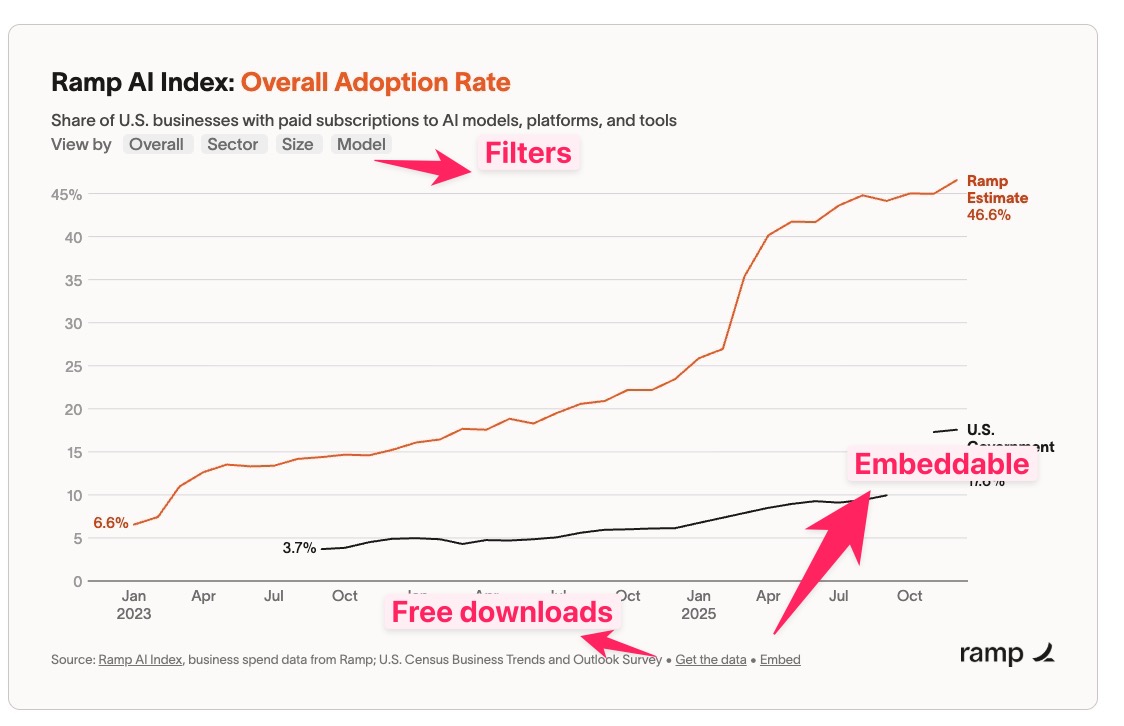
The AI Index uses Datawrapper for interactive, embeddable charts
One incredibly noteworthy part of this index distribution is basically exposing the underlying datapoints to anyone. This isn’t just a static chart. Ramp uses Datawrapper for embedding, allowing fully interactive visualizations that readers can explore, embed on their own sites, or even download. The embed includes multiple views (overall adoption, by business size, by model), time series data, and methodology notes all in one interactive package. This level of detail transforms a simple chart into a reusable research asset that journalists and analysts can cite and embed without friction.
Here's the kicker - they have the data available on third-party sites like Bloomberg Terminal and Macromedia . I love this play and do it myself but it’s something you VERY rarely see in the wild.
Of course, like any good index, they also publish explanations explaining how the dataset is built.
The second index is the Ramp Advertising Index, which measures share of businesses that have expanded their digital advertising spend. They break out advertising platforms (Amazon, Apple, Facebook, Google, Microsoft and others), eight different industries and spend by business size. This is the closest you’ll get to something a finance team will take back to their marketing team to ask why they aren’t dropping performance spend like their colleagues. And it checks all the boxes:
- High variance
- Strong applicability to target businesses
- Filter to ensure that the reader can find what lines up for their specific business type.
I’m not sure why it hasn’t been updated for four months but still love this.
Sample Embedded Chart
3) Ramp Rate: productized research + programmatic SEO + social bait (in a good way)
Ramp Rate just launched in January 2026 and is likely the best example I’ve seen of in-depth analysis. It marks a turning point in how Ramp leverages their spend data as a directory, not a dashboard, where every single vendor page is essentially a mini analyst research note.
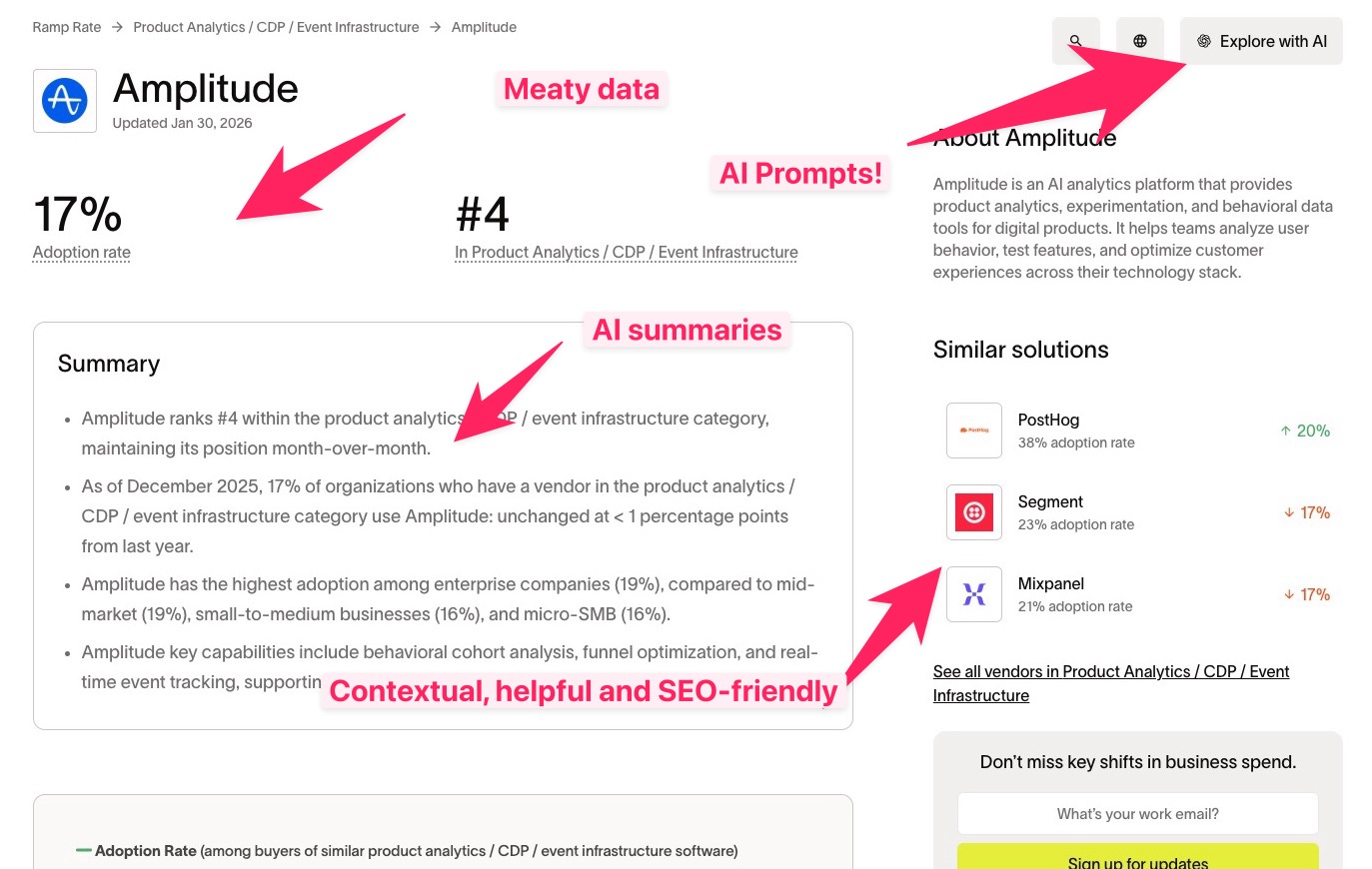
Each vendor page is a mini analyst note with consistent metrics and ChatGPT integration
Every insight, every comparison is grounded in what companies are actually spending—making it directly relevant to both customers and business users. What’s particularly ambitious about this evolution is how Ramp moved away from just the two indexes and began offering a much larger, multi-dimensional data set with more dynamic comparisons across vendors and caegories.
Now, instead of only tracking overall ad spend or AI trends, these vendor pages compare fifteen categories and 100 different solutions against each other. They surface category adoption rate, ranking, adoption change, trending vendors, and other performance metrics. There’s also a nice juicy programmatic FAQ section (nice job, GEO-optimizers!). Some of this data was already being shared in a static blog post fashion (see their December 2025 update here, for example) but this type of page is just vanilla awesome.
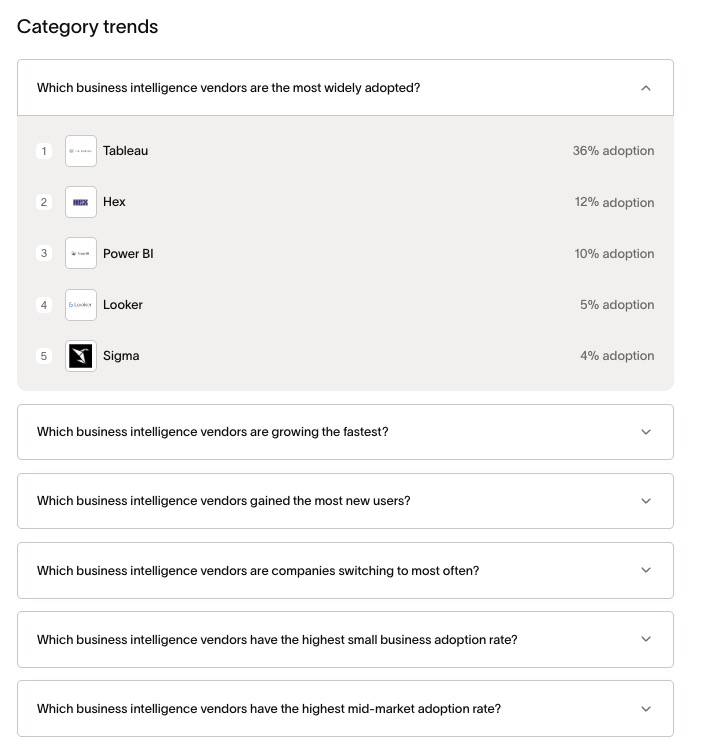
Programmatic FAQs ready for GEO
The data is all exposed and available. Each vendor page has history, spend by business size and so much more. The comparisons create a HUGE opporutunity that I assume Ramp just hasn’t had the time to play around with yet - tagging vendors that are overperforming on social and letting those companies push their datasets for them.
But…
As impressive as it is, some of this feels less relevant for finance teams than it is for early-stage founders comparing tools and vendor categories. That makes it better as a powerful brand signal for Ramp than bottom of funnel marketing for their ICPs.
One other great thing to flag is how pages are piped into ChatGPT with an “Explore with AI” button. This is a great forward-thinking interface choice that lets people dig deeper, ask domain-specific follow-up questions about the dataset directly from each vendor page and, most likely, send a signal to ChatGPT to use the data more.
Overall, this strategy unlocks huge opportunity: richer targeting for startups, social amplification, and brand-building as a source of economic “truth.” And it’s a signal of just how ambitious Ramp’s approach to data marketing has become.
The “this is genius” examples
Behind the scenes ongoing contentn.
Ramp has been publishing data-backed content since October 2025 in earnest. Much like my other fintech feature from a few months ago, they have business-level data that they cap. A nice example of unique reporting is a series they just did on restaurant rankings in big cities; the perfect “data journalism” Trojan horse.
The “Top 10 restaurants for business dinners in NYC/LA/SF” style posts are strategically brilliant because they:
- Feel fun and human
- Demonstrate unique visibility into corporate spend patterns
- Are repeatable without feeling like spam (because the data refreshes and the format is inherently shareable)
This is the kind of content that gets forwarded by execs who would never forward “Top 5 expense policy templates.” It’s also the kind of thing local media loves.
The cadence: the “playbooked hard” thing
Economics Lab was publishing at a wild clip: 44 posts across ~94 days (roughly one every two days). That’s a great operating rhythm that showcases how content can (almost) write itself when the data is readily available. Positioning yourself at the epicenter of monitoring spend during the rise of AI helps too :).
Distribution: the best “all-in” anecdote
This is the part most companies wish they could do when they have content.
Ramp uses at least four channels that I can spot regularly: 1. Authors and leadership. Ara is a powerhouse on LinkedIn with his posts. But unlike other companies, Eric Glyman, the CEO, gets invovled too. This has some great examples. I saw one of their pieces cited on Jason Lemkin’s (SaaStr) blog. When I looked at the image he sourced, it was from…Eric’s post on Twitter. When leadership gets involved in distribution, good things happen. .
Here’s the tweet:
And here’s the SaaStr post that included an embedded graphic from that same post on SaaStr.
2. Media. TechCrunch used Ramp’s AI Index as the spine of a news story. TechCrunch article. Fortune picks up the data. Do does BI and a long tail of newer publications and Substack. As I said before though, the combination of recognizing the power of humans + pairing with a good PR team rsults in good things, like this Yahoo Finance video piece that featured Ara on video explaining the work. This is a huge “treated like real research” signal.

Ramp's research gets picked up by major media outlets, with Ara featured as the expert
One PR potential could be more regular distributed pitches, like what Redfin’s data marketing play taps. That said, the behind the scenes pitching seems to be doing a strong job.
3. SEO. None of Ramp’s data-driven pages even make it into the top-ten of their organic traffic pages (unlike, say, Redfin, where the data pieces are front and center). I assume these pieces will get cited and will start generating more traffic. Time will tell.
4. Substack. This is fully owned by Ara and available right here. I can’t say how much I love this. The stack is an owned channel that directly hits your inbox, can expand audiences and engagement, and sticks out from typical brand emails. I don’t know if the SEO gods like the duplicate stack and website content but having the personal brand + the earned media input with a seperate branded newsletter almost certainly justifies that SEO slap on their wrist.
What Ramp can improve (aka “you’re already good, now get annoying in the right ways”)
-
Make content subscriptions granular and obvious. Ramp has Substack subscription prompts on the index pages, but it’s not always clear what you’re subscribing to, and where the CTA should live on every surface. Let people subscribe to specific signals, like AI adoption inflects or the Advertising Index crossing a specific threshold.
-
Consolidate “where research lives”. Velocity, Economics Lab, quarterly reports, and Vendors are all strong, but the ecosystem is slightly fragmented. A single “Ramp Data” hub with a simple map (cadence, what’s ungated, what’s embeddable, what’s downloadable) would reduce friction and increase reuse.
-
Gated? Really? Ramp did have a quarterly report that was oddly gated since far more valuable content was available ungated. The more awkward part was the download domain didn’t have HTTPS so I couldn’t download it 😱.
-
More top-of-funnel capture on research surfaces. I actually WANT to subscribe to this resaerch but it’s completely missing from the homepage or higher-trafficked pages. If the research is truly a top-of-funnel engine, treat it like a product page: clear CTA, clear value, clear frequency.
-
Pull more execs into the loop. Getting the CEO involved is awesome but other execs aren’t there (example: Colin Kennedy never metninos it. More leadership voices amplifying the same research reduces key-person risk and increases audience overlap.
-
ICP-centric data. Ramp is killing it at brand (even before they got The Office’s Brian Baumgartner for a Super Bowl spot). The data they publish supports this really well. But I’d love to see the data explored to find more insights and indexes that will specifically pop for the VP Finance (or whoever is making the Ramp purchase decision). The advertising index is perfect - let’s see more of that!
Practical things to steal for your data marketing
- Ungated, embeddable benchmarks, both high level (AI model payments) and in depth, with their new vendor scorecards
- Third-party distribution, using channels like Bloomberg Terminal
- Exec to analyst distribution, from CEO on X to strong concentrated media play
- Marketing savvy data analysts. There’s a meticulous funnel, from Ara’s welcome to Substack email to on-page CTAs
- Build up writer expertise - content writers aren’t content writers. They showcase their expertise on author pages.
- Ready for ChatGPT prompt links - each vendor page includes “Explore with AI” functionality
The marketer takeaway: why this works (and why it’s hard to copy)
Ramp’s advantage isn’t “they have data.”
It’s that they run the full circuit:
Data → methodology → human analyst voice → interactive assets → repeatable formats → exec distribution → third-party pickup
Most companies do two steps and call it a strategy. Ramp does the whole loop. And I’m sure that the loop compounds.
Part of the Data Marketing Teardowns series
Let's make a deal. Drop your email and I'll let you know when I post new insights.